

no empty word
on deuteronomy, remembrance, and sing-a-longs


“Take to heart all these words to which I give witness today
and urgently command your children to put them into practice,
every single word of this Revelation.
Yes. This is no small matter for you; it’s your life.” ‘
I am agitated — the good kind — about the Bible’s words of life and the Word (Jesus) who IS our very life. I feel stirred up about the goodness of the scriptures and the kindness of God to reveal Himself to people. I’m taking note and marking this down, because it happens so rarely that my sensory experience aligns with my intellectual convictions.1
I’m thinking of the ways that the Word (the words of the scriptures, for my purposes today) produces immense fruit in the life of those who hunger and thirst and abide. I’m thinking about all the commands and promises of God that Moses recorded for the Israelites and the song2 that the Lord commanded Moses to write & recite for the people, so that even though they would wander and reject God’s ways and forget Him and worship other gods, they would have the words of the one true God inexorably sealed into their memories.
The song is bold and terrifying, liberating and strengthening; it’s appalling and it’s comforting. It prophesies about the ways that the people of Israel will become “fat and unruly”3 (lol same sometimes, God help me) but it also recounts and promises the ways that God comes near, nourishes, strengthens, and upholds them anyway (praise). It’s His covenant promise to never leave them, even though He knows they’ll be unfaithful, ungrateful, and willfully untethered from His loving protection.
And after Moses goes with Joshua, to recite the whole piece to the people, he concludes with this striking directive:
“Take to heart all the words of warning I have given you today. Pass them on as a command to your children so they will obey every word of these instructions. These instructions are not empty words — they are your life! By obeying them you will enjoy a long life in the land you will occupy when you cross the Jordan River.”4
These instructions are not empty words — they are your life.
The Hebrew word for life is an adjective form of the root word חָיָה / ḥāyâ.5 While it’s translated simply as life here, it has a broader scope that includes ideas of sustaining, revival, and restoration to life. This is the kind of life you would need if you were, say, an Israelite returning to the covenantal love of Yahweh after a time of rebellion and rejection.
Or, say, a twenty-first century woman poring over the pages of her Bible after a time of spiritual drought, finding all over again the blessed relief of God’s keeping power and His reviving love.
The poem/song Moses recited and urged the Israelites to commit to memory hearkened back to all of the covenant laws and love of God. The poem wasn’t disconnected from the full law; it was likely meant to be a summary reminder of what God’s promises were and what the people’s participation ought to be in response. It’s possible that some of the listeners (and some readers here) would have had the sense that they’d heard that admonition before — it tickled a memory of another teaching they’d received earlier:
'“Listen, O Israel! The Lord is our God, the Lord alone. And you must love the Lord your God with all your heart, all your soul, and all your strength. And you must commit yourselves wholeheartedly to these commands that I am giving you today. Repeat them again and again to your children. Talk about them when you are at home and when you are on the road, when you are going to bed and when you are getting up. Tie them to your hands and wear them on your forehead as reminders. Write them on the doorposts of your house and on your gates.'"6
It’s another exhortation to remembrance — a call to store up the life-giving commands of God (which, as you may recall, are not burdensome7) and keep them at the front of your mind and in your conversations. Later, Solomon would pen the proverbial counsel to “write them on the tablet of your heart”.
This is all pointing to (the theme of my life apparently): remembrance.
The same instruction Moses issued to the people is the same invitation to twenty-first century believers: Remember this. Commit this to memory. Come to know the sustaining life of the one true God as you tell of His wondrous deeds. He’s never going to fail, His justice is perfect, and His ways are always right. You’ll need to remember this because there are times when you’ll think God has wronged you, departed from you, neglected you. You’re going to need to call to mind His love and promises, you’re going to need to drink from the well of living water, eat from the bread of life — so tuck this into your memory, write it on your heart, because these words and THE WORD are going to bring reviving, restoring life to dry bones.8
The promises were meant to be preserved in their collective memory —in our memories, too— and the mechanism was poetry + music.9
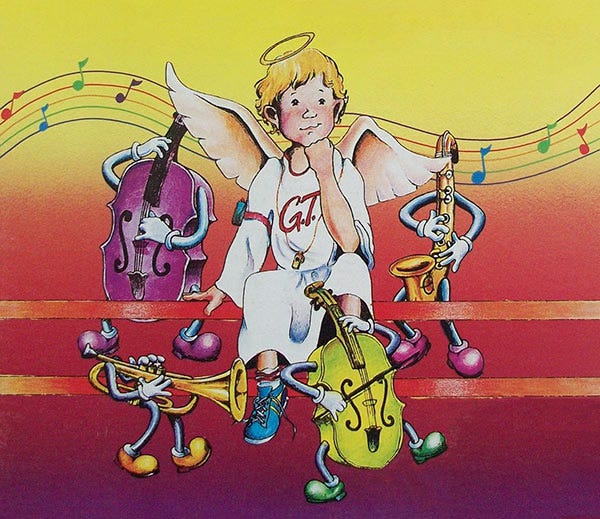
When I was a kid, I had a collection of cassette tapes featuring not only my favorite Disney soundtracks, but also the niche late 80s classic Christian series: G.T. and the Halo Express.
G.T. (Good Tidings) was an angel who, if memory serves, visited a brother/sister duo who were frequently getting into scrapes and/or memorizing related scripture verses (maybe?) and he encouraged the duo, even wrestling with them through whatever issue they were facing. The storytelling was punctuated by scripture set to music, which is why to this day I can still call to mind passages like Isaiah 41:10 or John 16:33 by humming ye olde 80s tunes.
My own kids were subjected to a similar approach when they were smallish: Seeds Family Worship and Slugs and Bugs were on frequent rotation in our home, because I wanted the words of God saturating their developing vocabulary — and because there is something about music that makes ideas and concepts stickier. We sing songs of worship and remembrance in our church services as a way of remembering and reorienting ourselves to God’s truth and rejoicing in His presence and goodness.
You may not be the sort of person who wakes up one day and says I’M GOING TO MEMORIZE A POEM! but I bet you actually know exponentially more poetry and verse than you think.
You may call to mind that a lamb followed Mary to school one day and I bet you can remember what color its fleece was. If you have an 80s/90s youth, perhaps the appreciative musings of Stanley Kirk Burrell echo through your brain uninvited:
Music hits me so hard / makes me say “Oh, my Lord, / thank you for blessing me / with a mind to rhyme and two hyped feet”10
And who among us hasn’t suffered from commercial jingle earworms? I can’t unknow the statement of the great mint: it’s double the pleasure, double the fun, of course11.
I digress.
God’s instruction to Moses was to learn the promises, prophecies, and provision of Yahweh through that song and teach it to the people, who would teach it to their children, so that it would stick. This wasn’t an empty exercise, akin to busywork. It was the Creator making use of His own cognitive design to strengthen recall. It was Infinite Love outfitting His finite forgetters for the work of remembrance.
The scriptural canon even has its own songbook embedded in it: the psalms. While not technically a hymnal, the compilation of prayers, poems, and songs span over a century of Israel’s history12. The psalter, collected laments and desperate prayers and songs of celebration, would become another resource for remembrance — one that God’s people would use for centuries to remember His goodness and His promises.
The Israelites learned to sing, so they would remember Yahweh’s heart for them. The Jewish people recited the poetry of the psalms, which gave voice to their own desperation, longing, and rejoicing.
And in the twenty-first century, (s)he who has a Bible or access to a music streaming platform, let her/him hear: you can strengthen your own recall with poetry + music. You can remember.
The words of God are not fluff or artificially generated slop. They are packed with prophecy, promise and presence. They are rich with the beauty of His endless love and generosity. They are a lamp and light to those who feel darkened by forgetfulness.
They are, as Moses said, no empty words for you — but your very life.
I’m glad you’re here,

Thanks for reading The Good Words! If this was a good read, pass it along to a friend?
Oh wait! Before you go —
I love sharing things I’m using, enjoying, learning. My post-script is almost always going to be a resource gush.
A favorite artist who sets scripture to music. And an album worth trying.
A book on my TBR about scripture memory.
Okay, that’s really all, folks.
(Unless you’re into footnotes).
Peace be unto you!
This is a normative experience for humans; this is a normative experience for Christ followers. Sensory experiences —which we feel emotionally or in our bodies— are real and necessary and are not the final measure for reality and like the historic church, I don’t expect the life of faith to be without seasons of doubt, darkness, or wandering. I am not a follower of the Way of Jesus because it’s an emotional anesthetic; I am follower of Jesus because of the veracity of the whole historical and supernatural narrative.
Deuteronomy 31:19-22 (the instruction); 32:1-43 (the song)
32:19
32:46-47
When you pronounce it, it almost sounds like you’re saying HI-YAH! which was a very satisfying and humorous research discovery.
Deuteronomy 6:4-9
1 John 5:3
IS THIS THE WHOLE STORY OF THE BIBLE?! Maybe. I probably pulled in too much flowery imagery but I did warn you that I’m stirred up today.
THE ALLITERATION IN THAT SENTENCE AMIRIGHT?!